
The One-Sentence Rule, and Its Exceptions
If your garage door can't hold its position under wind pressure, nothing else in the garage matters. The exceptions: a door that's brand new, rated for wind load, and properly braced doesn't need the same urgent attention as one that's ten, fifteen, or twenty years old with original hardware. The exceptions also include doors that have already been retrofitted with bracing kits or impact-rated panels — those just need a seasonal inspection, not a full overhaul.
Why the Garage Door Is the Weakest Wall in the House
Most exterior walls are solid, load-bearing structures. A garage door is a large moving panel held in place by springs, tracks, rollers, and a handful of hinges — it's mechanical, not structural, and that's exactly the problem. When wind hits a house, pressure builds on the windward side and pulls on the leeward side. If a garage door buckles inward, that sudden pressure change can push upward on the roof from the inside, which is how a failed garage door turns into a lost roof. This is why wind-load ratings exist for garage doors in storm-prone parts of Florida: the door has to resist both the push and the suction without caving or lifting off its tracks.
On older homes throughout Raiford, Starke, and the surrounding Union County communities, doors installed decades ago often predate current wind-load expectations. They may look fine sitting still in the driveway but were never engineered to resist sustained gusts, which is a very different test than daily opening and closing.
What Wind-Load Readiness Actually Looks Like
- Reinforced panels or horizontal struts that stiffen the door across its width so it can't bow inward under pressure.
- Heavier-gauge tracks and lag screws anchoring the track to the framing, not just to drywall or thin trim.
- Properly sized springs and secure cables — if a cable is frayed or a spring is already weak, the door has less reserve capacity when wind load gets added on top of its own weight.
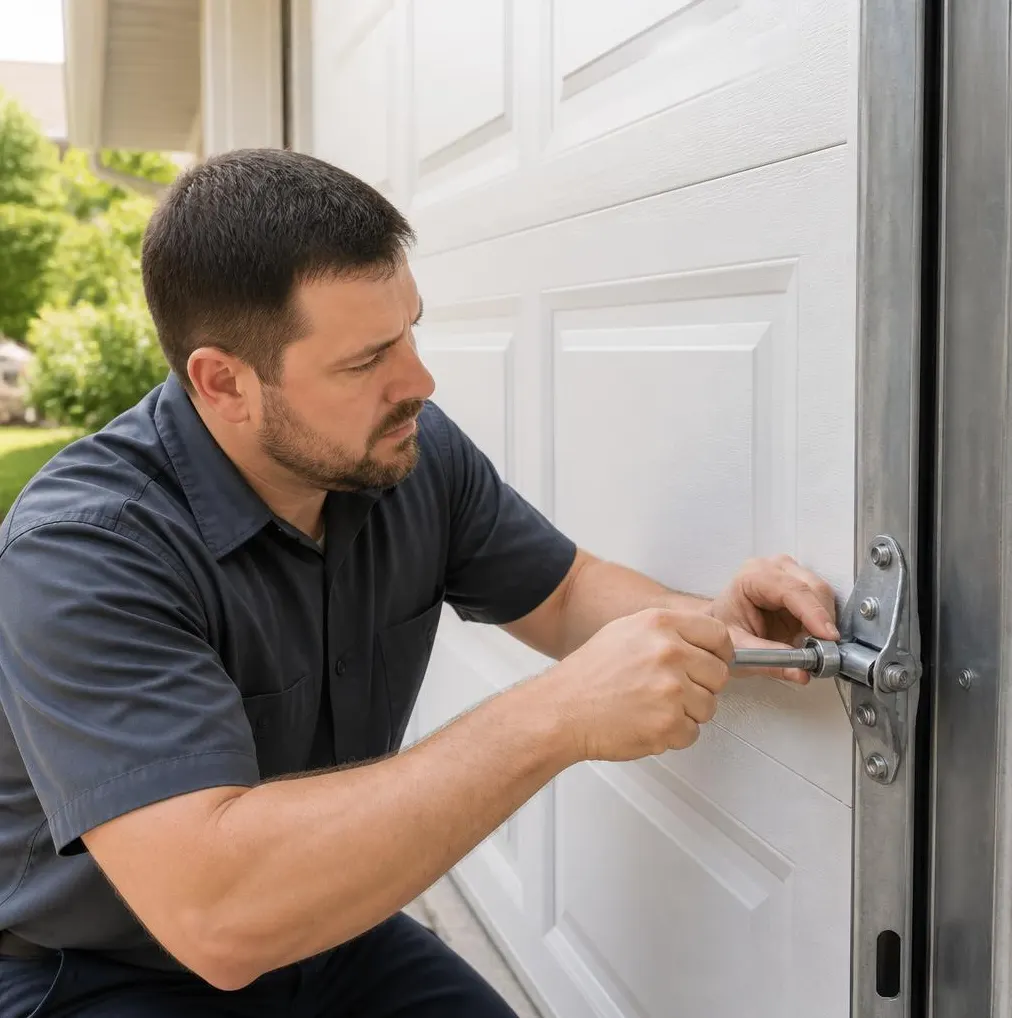
- A reinforced bottom bracket and functioning end hinges, since these are common failure points during sustained gusts.
If you're not sure which of these your door has, that's reasonable — most homeowners never think about it until a storm is already on the radar.
Humidity, Salt Air, and the Slow Damage You Don't See Coming
Long before wind becomes the issue, Florida's humidity is already working against the door. Wood and composite panels swell in sustained moisture, which can throw a door out of alignment with its tracks even on a calm day. Metal hardware — springs, hinges, tracks, fasteners — corrodes faster in salt-influenced air, and rust doesn't announce itself with a loud noise. It just quietly weakens the metal until the day it's asked to do more than usual, like hold against gusting wind.
Afternoon downpours common this time of year compound the issue: water pools near the threshold, seeps into the bottom seal, and keeps the lower section of the door perpetually damp. That's the section most likely to rust first and the one bearing the most stress if wind pushes against the door.
A Practical Pre-Storm Checklist
- Test the balance. Disconnect the opener, lift the door halfway by hand, and let go. It should stay put. If it drifts up or crashes down, the springs are compensating poorly and won't hold up under added wind pressure.
- Inspect cables and rollers. Look for fraying, rust, or rollers that wobble in their tracks. A compromised cable is far more likely to snap when a storm adds extra force to normal operation.
- Check the track alignment. Gaps between the rollers and track, or a track that's pulled away from the wall, mean the door isn't being held as securely as it should be.
- Look at the bottom seal and threshold. A worn seal lets water in during downpours and gives wind a place to catch the edge of the door.
- Confirm the opener's emergency release works and that you know how to manually lock the door in place if power is lost mid-storm.
- If you don't already have reinforcement — horizontal struts, a wind-rated door, or an aftermarket bracing kit — this is the time to ask about it, not after a watch has been issued.
Trade-Offs Worth Knowing
Bracing kits are the lower-cost route (often in the low hundreds of dollars as a national range) and can retrofit an existing door, but they don't fix an underlying alignment or rust problem — they just add stiffness to what's already there. A full wind-rated door replacement costs more upfront (commonly several thousand dollars as a national range depending on size and material) but resolves the spring, track, and panel-strength issues all at once, which matters more on an older door that's already showing wear.
When to Call Raiford Overhead Door Co
If your door fails the balance test, has a frayed cable, or won't sit flush in its track, don't wait for a storm to find out how bad it is. Our team handles Garage Door Cable Repair and Garage Door Spring Repair for homeowners dealing with exactly these symptoms, and we also perform Garage Door Maintenance visits that catch rust, misalignment, and worn seals before they become storm-season emergencies. We've worked on doors across Raiford, Starke, Lake Butler, Lawtey, Hampton, Worthington Springs, Brooker, and Waldo, so we know the moisture and wind issues specific to this part of Florida.
If you've been putting off garage door repair in Raiford FL, now — before the next system forms — is the time to get it looked at. Call Raiford Overhead Door Co today to schedule an inspection and head into storm season with a door you can actually count on.