
The Moment You Notice It
You hit the opener button on a chilly November morning, coffee in hand, and instead of the usual smooth roll-up, the door groans, jerks a few inches, and stalls. Maybe it reverses halfway and slams back down. Maybe it opens, but slower than you've ever heard it, with a grinding or scraping sound that wasn't there last week. In some cases the bottom of the door looks stuck right to the concrete slab, like it's glued there.
It's tempting to call this a "frozen" door, and in a sense it is — but in north Florida, the culprit usually isn't ice forming overnight. It's the combination of cooler temperatures, heavy humidity, and moisture that's been soaking into your hardware all year. Cold weather just exposes problems that were already building.
Common Symptoms Homeowners Report
- Door is noticeably slower to open or close than usual
- Opener motor strains, hums, or clicks without moving the door
- Door moves in jerky starts and stops instead of one smooth motion
- Door reverses on its own partway through the cycle
- Loud grinding, squealing, or popping from the tracks or springs
- Bottom seal appears stuck to the garage floor, requiring extra force to break free
- Door feels unusually heavy when operated manually
What a Technician Checks First
1. The Bottom Seal and Threshold
This is the first thing worth ruling out, since it's the simplest. The rubber weatherstrip along the bottom of the door can swell slightly after absorbing moisture from humid air or standing water on the slab. Overnight, as temperatures drop, that swollen rubber can press tightly enough against the concrete to create real resistance — it feels like the door is frozen down even though there's no ice involved. The fix is straightforward: clean the seal and the slab, let both dry fully, and replace the weatherstrip if it's cracked, flattened, or no longer sealing evenly. A fresh seal also helps block the gap that lets humid air and pests into the garage.
2. Lubrication on Rollers, Hinges, and Tracks
Grease behaves differently in cooler weather — it thickens and doesn't flow into the roller bearings and hinge pivots the way it does in the heat of summer. If your garage door hasn't been lubricated in a while, this is often the real source of the jerky, hesitant movement. The fix: clean off old, gummed-up grease with a rag and a household degreaser, then apply a silicone-based garage door lubricant to the rollers, hinges, and the track itself. Avoid WD-40 or heavy oils as a long-term fix — they attract dust and grit, which makes the grinding worse over time.
3. Track Alignment and Rust
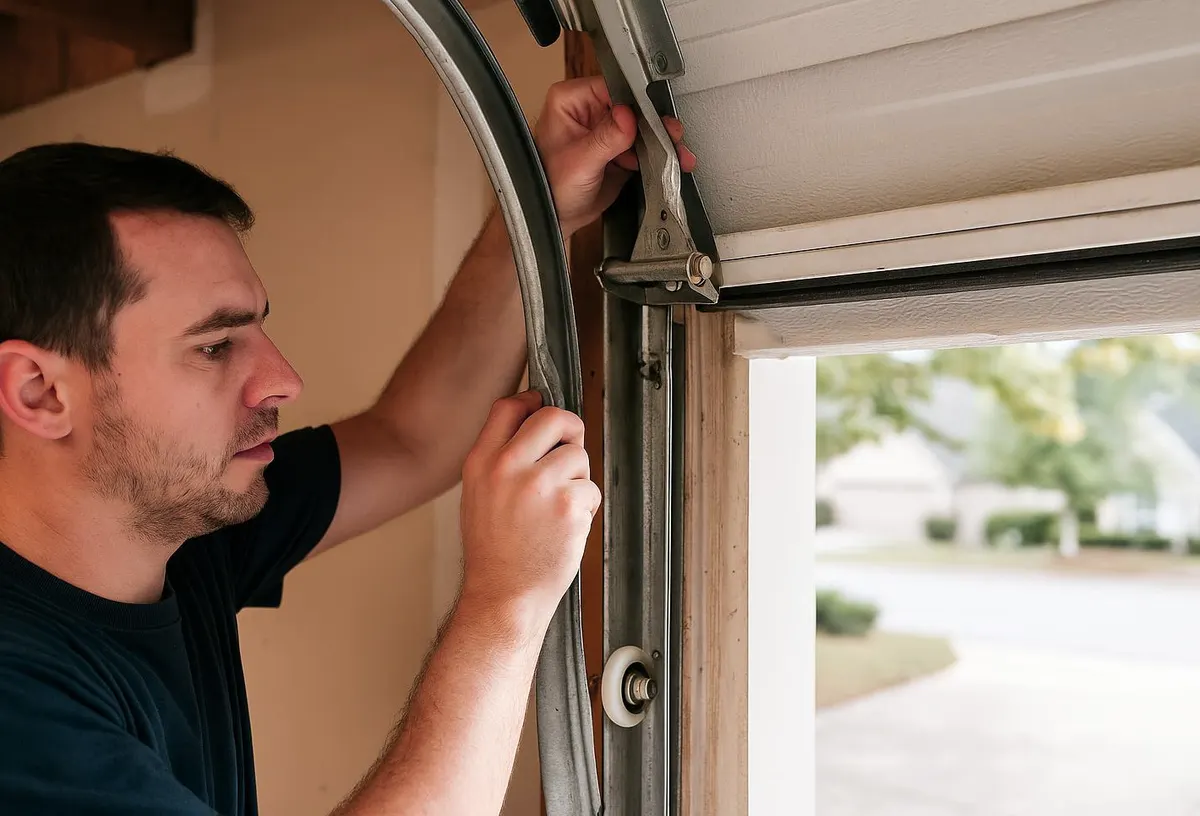
Florida humidity doesn't just affect grease — it affects the metal tracks themselves, especially if your garage sits anywhere near standing water, sprinklers, or gets regular afternoon downpours blowing in under the door. Surface rust can form on the tracks, creating friction that the rollers have to fight through. Humidity can also cause minor shifting in the door jamb or framing over time, nudging the tracks slightly out of alignment. A technician will check the tracks with a level, look for rust spots or dents, clean and treat light rust, and realign or tighten the track brackets if the gap has widened or narrowed unevenly.
4. Spring Tension
Torsion and extension springs are made of steel, and steel contracts slightly in cooler temperatures. On a door that's already borderline — springs nearing the end of their lifespan or already weakened by rust — this small change in tension can be the difference between a smooth lift and a door that strains, stalls, or won't lift at all. This is also where coastal salt air and general Florida humidity do long-term damage, since moisture accelerates spring corrosion even well inland. If a technician finds pitting, flat spots, or a spring that's visibly stretched or gapped, it needs to be replaced — springs are under serious tension and not a safe do-it-yourself repair.
5. Cables
Garage door cables work alongside the springs to control the door's descent and lift. Like springs, they're vulnerable to rust and fraying from humidity, and a damaged cable can cause the door to hang unevenly, jerk to one side, or bind up entirely. A technician will inspect the cables for fraying, rust, or looseness at the drum, and replace any cable that shows wear rather than waiting for it to snap.
6. The Opener Itself
Last on the list, because it's the least common cause, is the opener motor and gear assembly. Cold can thicken the internal lubricant in an older opener, making the motor work harder and sound strained. If everything else checks out — seal, lubrication, tracks, springs, and cables — but the door still struggles, the opener's gears, chain tension, or safety sensors may need adjustment or servicing.
When to Call Raiford Overhead Door Co
If you've cleaned and lubricated the obvious parts and the door is still sluggish, jerky, or stuck, it's time to get a trained eye on it — especially if springs or cables are involved. Our team handles Garage Door Spring Repair and Garage Door Maintenance for homeowners throughout Raiford, Starke, Lake Butler, and the surrounding Union County area, and we check the whole system in the order above so we're not just treating a symptom. We'll tell you plainly whether you need a quick lubrication service or something more involved, and we won't recommend a repair you don't need.
If your garage door in Raiford, FL is dragging, grinding, or sticking as the weather cools down, give Raiford Overhead Door Co a call — we'll get it moving the way it should before the next cold morning catches you off guard.